
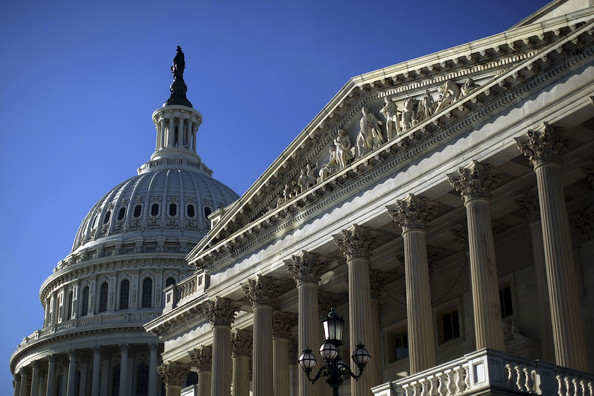
The United States House of Representatives has 43 African-Americans who serve currently, and there have been 126 since 1789. While it may seem easier to be elected to the House as an African-American that is not a fact. It is less difficult in that many of the districts that a majority of these members represent are from people who look like themselves. This is turn usually makes it tougher to broaden the appeal that would be needed for seeking a United States Senate or any other statewide elected office.
One major difference also between African Americans and, lets say other marginalized groups, i.e. women, is organizational. African-Americans have no real major PACs (Political Action Committees) or organizational structure that are solely dedicated to elected African-American men and women to serve in the Senate. There are countless womens groups, such as the Susan B. Anthony List Candidate Fund. According to a study done by Rutgers University, there are over 50 PACs that are primarily focused on seeing women being elected to office. Personally, I see this as women understanding the collective responsibility they bear to see progress in a nation which usually stalls on issues that are important to them. African-Americans, in my humble opinion, don’t think this way.
If we field a good black candidate, then there should national effort among African-Americans to ensure that individual has success in their respective race. The theme of collective responsibility, once the bedrock of the African-American community, seems to have ebbed as the ocean does from shores of the Earth. However, African Americans are not the only ones who have to be convinced. These potential candidates need to have a broad appeal that would allow them to serve the interest of their states as well as fight for issues that concern the African-American community, which in a great deal of states are one in the same. It was the case with Barack Obama who ran successfully for the U.S. Senate in 2004, though his original opponent dropped out of the race and the successor to that opponent was as extreme and Hitlerian as one could be in his right-winged views. Mr. Obama proved he could do it on a national level with his runs for the Presidency in 2008 and 2012. But, has the Obama effect hurt or helped African-Americans who would seek a Senate seat?
Obama: Helped or Hurt?
In most cases the President has both helped and hurt those who would seek higher office around the nation. African-American candidates are now held to the “Obama standard.” The standard of having a broad appeal to not only African-Americans and members of your own party, but to attract young and old; black, white, hispanic, asian; as well as independents and those from across the aisle. Believe me, there are candidates out there with that type of appeal. Blacks like Bakari Sellers who won election at age 22 to the South Carolina House of Representatives, men like Governor Deval Patrick of Massachusetts, or Kamala Harris, the current Attorney General of California. Or Kendrick Meek, former U.S. Representative who was unsuccessful in his bid for the Senate in 2010, mainly due to Charlie Crist running as a Democrat and syphoning votes from him and allowing Marco Rubio to be elected. Damon Dunn, candidate for California Secretary of State (2010) although a Republican, could be a viable candidate as well to break down “the other glass ceiling.”
The people are out there, what we are lacking is the organization and the resources to successfully win at the highest levels. While the President doesn’t have to personally support these candidates he could be helpful in offering key staff members and strategist as well as cajoling the leaders of the Senate Campaign and the Democratic National Committees to seek viable African American candidates. The major question is will he bear this cross, or will African Americans continue to be blacklisted as was the case in the 2012 Senate election cycle?
If we were to analyze making a move from the House of Representatives to the United States Senate by any of the 43 current members of the Congressional Black Caucus, it seems that most don’t have that broad appeal. By appealing to only “black” issues it seems they have placed a limit on themselves to be seen as persons who can move to the next level. While I do not fully agree with this, it seems to be the argument. This does not diminish their roles as policy makers however, I think it enhances it and brings to the table something that is vital. That being an outlook that would serve even the most avuncular of Senators well. As Senator Ben Nelson, a Nebraska Democrat said, “…any time you have a cross-section of American people in any decision making process, you improve the quality of decisions.” Nelson understands this as I believe many others in that body. But, the most significant of questions is what will be done? Think about the debate on the high levels of poverty and inequality in this nation that could be had with more African Americans in the Senate.
Conclusion
We have to ask ourselves the question: How can we further perfect our union and make good on the promises of the founding fathers? 1 African American Governor out of 50, 0 United States Senators out of 100, and 43 Congressman/woman out of 435 is NOT getting it done. We need real action, organization, and people who are willing to step up to make this a worthwhile cause. I’m willing to bear that burden not only for my people, but my state and my country. America deserves better. American can do better than what we have produced. If Democrats and Republicans want to really get serious, then more African American candidates need to be sought out. Furthermore, they’ll need the backing financially of the party and the organization to win these races.
This is an opportunity for 2014 and beyond to see the Senate have African-American membership and to eradicate the myth of a sign that hangs from the North Wing of the United States Capitol reading “For Whites Only.” Can it be done? Yes, but only with a concerted effort of collective responsibility and determination of individuals who want to make history and fight for the issues of our time. It starts now!
ADF





I'm barely functioning at the moment, but I did want to leave a quick response…
…there's one small phrase that tells a majority of the story: the fact that there's one African-American governor. Gubernatorial elections are subject to the same voters as senatorial elections. We can throw out quite a few of states which we know will never elect an African-American to a statewide position, probably half of them. We can eliminate quite a few others off the fact that there isn't enough of an African-American population to help elect an African-American. I'd say (without deep thought) that maybe ten states are even slightly possible locations from which an African-American senator can develop. There's also the fact that many senatorial elections occur in midterm years, when African-Americans are less likely to vote. That's before we even get into the issues discussed in the piece such as financing.
Okay, my time's about up. I'll finish by saying these don't make the task impossible (obviously), but they are limitations that any African-American senatorial candidate would have to address throughout – or preferably, long before – they start campaigning.
My recent post My Five Favorite Sitcoms Of All Time
Wait, my brain doesn't really get going before noon. Did I read the first paragraph correctly? Neither house will have any African American representation? Not one among the hundreds in the lower house???
James Clyburn is still in the House of Reps. and Keith Ellison as well. There are a few other black representatives, but not many.
No I state in the article that there are 43 blacks who serve in the house.
The senate (and governor) is an entirely different race than running for say a House seat. The demographics are entirely different, which is why I'd argue that many of those who are beloved by their districts in the house choose not to run statewide, just a more difficult sale.
Also, many of the Black politicians run on primarily Black issues. This is cool in terms of city and county races, but when doing state races where there isn't one state where Blacks are a majority, its a much more difficult task. in Mass, Patrick ran on a more middle class agenda similar to what Barack ran on. Many in our community don't see the benefit of such a campaign as its not centered around Black issues though.
But as the demographics of America (and thus states) change to a majority minority population, we're likely to see the primary interests of voters change and the set of candidates running for statewide offices more diverse.
My recent post Learn About “the Other” Algebra
It seems like more black folk are less interested in running for political office at all, unless there is a high concentration of African-Americans in their respective district. Getting elected is hard, even if the area in which your running knows your face. But to run for a Senate seat, where you have to be elected by a whole state? That seems to be an insurmountable mountain at this point.
I’m more on the side of the Obama effect has been negative. The racial tensions in the country have ratcheted up, and as long as one of us is in charge, there will be no more advancement for another.
This article is just sad. Very true but sad. I think part of the problem is that the average American (black, white or other) doesn't really understand how politics work. Most people don't know who their Senators are, more or less when to vote for them, or how to campaign for them etc. Most of my friends only vote in Presidential elections (or when they were gonna start selling alcohol on Sundays). Half of my friends who do vote for something other than President don't even know who the candidates are and will literally call me on the way to vote asking me who they should or shouldn't vote for. I don't really know how you can convince people to care but I think that's where it has to start.
"The House, however, has the exclusive power to initiate bills for raising revenue"
Hate to pull the race card but I believe this is the reality. Caucasians will Always control the money in this country in some way, shape, or form. Regardless of who is the president, in the Senate or the house.
Even though we have a black president, the Republicans have control of the House. To a certain extent, even though the Republicans lost the presidency, they won where it counts.
"The major power of the House is to pass federal legislation that affects the entire country."
Point is, the House of representative has more power than the Senate. I believe "they" knew exactly what they were doing with that move.
What many people don't realize is that even if we did get a "freedom fighter" Malcolm X or Black Panther type of guy in the White House on any State Level and beyond, white people will balk and fight it and nine times out of 10 win.
President Obama is very clever in how he handles things with regards to legislation and passing bills in the White House. He knows that if he gets too Black Pantherish and tries to "do too much" specifically for black people, and/or even speaks on doing to much for black people that he will, #1. be labeled as a "typical negro" continuing to enable and passify "his" people; and #2- trying to unfairly give us lazy negro's everything for nothing.
i think the biggest issue in terms of electing blacks to senate or governor positions, is quite frankly, the funds needed to campaign effectively. i don't know excat figures, but i'm pretty sure that the amount needed to run a successful senate campaign is much more than the amount needed to run a sucessful house campaign.
I have several years of experience working in Corporate America. You cannot just do whatever you feel is right just because your in a position of power. The same people who give you the power can snatch it right back quicker than a NY minute. It takes time, patience, and strategic and careful planning to do things that go against the grain and appear to benefit a specific group of people, (particularly us).
At the first property management firm I worked for, the white "Principal/Owner" decided to give all the black people MLK day off. All the white people fumed and were livid. The CEO & CFO told him to never ever do anything so "politically incorrect" and unfair ever again. After that we all had to work MLK day.
I do agree that more should be done to ensure the same opportunities that are afforded to caucasians are afforded to all minorities, (we are not the only minority).
As President Obama has stated, we need to do more locally before we can invoke any major changes nationally. Starting with voting locally and getting more involved in local government as much as we do nationally. Many of us don't vote half as much as we should for local people who run for offices, like state representatives, congressmen/women, and city councilmen/women.
The more we can infiltrate the private sector of government, the more of a difference we will make, and the more our voices will be heard, and our rights acknowledged in the public sector of government. Once that happens then we have a much better chance of infiltrating higher more powerful branches of government like the House of Representatives.
Looking forward for when you decide to run for the position.
really thorough article.
sad that there will be no AAs in the Senate. But i can't say that i'm completely surprised. takes a LOT of money and supporters with a lot of money, to get a seat in the Senate. Like Nubian, i look forward to hearing about your run for office!
My recent post too much, too soon?
You might actually get your wish….b/c Sen. Jim Demint from SC just resigned this morning to take a job at a "think tank" for $1 mill a year. The word in SC is that Rep. Tim Scott (a black republican congressman) is one of the front runners.
I just read an article on that. I imagine Scott is hardly the type that the author had in mind, but his inclusion would open up a discussion of 'descriptive representation vs. substantive representation'.
My recent post Holiday Matters II
They’re saying Cory Booker might take over for Lautenberg in NJ (sorry for the spelling)
http://www.publicpolicypolling.com/main/2012/11/b…
& DeMint retired today–they’re saying a black Republican might replace him
http://www.washingtonpost.com/blogs/the-fix/wp/20…
Since working on President Obama's 2008 and 2012 campaigns, I have thought about running for office myself. My Dream Job is to be a FBI Agent or a U.S. Marshal, which is why I'm in college in the first place, so I want to put all my hard work and training to use before I decide to transition to Politics.
Look Forward to a Senator Fields in the Senate one day